Exploring the Essentials resources support you to advance balanced, faith-rooted climate actions that prioritize justice, center love, and respond to the needs of your community by aligning your actions to the Four Essentials of UU Climate Action: Justice, Community Resilience, Mitigation, and Congregational Transformation.
Mitigation: Reducing emissions from energy usage, transportation, waste, & consumption
What is the Mitigation Essential?
Mitigation is basically removing the pollution - reducing the greenhouse gas emissions - that cause climate change. It’s also understanding and rejecting the systems of harm that are the root causes of the crisis. It’s about advocating for solutions (like renewable energy) and fighting against extractive systems (like mining copper for renewable energy) while acting in accordance with our values (prioritizing human rights and Indigenous sovereignty). Mitigation requires that we hold complexity. For example, we need renewable energy to end the era of fossil fuels and renewable energy systems use up to five times more copper than fossil fuels while the San Carlos Apache Tribe is fighting to protect Chi' chil Bildagoteel aka Oak Flat, a Sacred Site to the Apache and other Native Nations, from copper mining.
Mitigation can feel very technical: reduce emissions. Because we are people of faith, our approach to Mitigation needs to be every bit as grounded in our values and commitments to loving justice as the rest of the Essentials - Community Resilience, Justice, and Congregational Transformation. While reducing the emissions that cause climate change is absolutely critical to a livable future, without centering justice in our mitigation efforts, we run the risk of unintentionally advancing policies that hurt our communities and run counter to everything we hold sacred. The question should always be, “are we centering love and prioritizing justice?” and if the answer is “no” or “hmmmmmaybe…?” we should pause. Even if the work is technical. Especially if the work is technical like mitigation often is - because technical work can feel like it’s not justice work, when it is. And when something doesn’t “feel” like justice work, that’s when we’re most likely to unintentionally do harm.
Read this month’s Exploring the Essentials: Mitigation below for more about how the Mitigation Essential helps our communities, learn what other congregations are doing, and find resources to support your Mitigation work.

If you appreciate this work please consider supporting the Green Sanctuary 2030 program with an individual donation or by organizing a pass the plate to make sure all UUs have the support they need to transform our communities through climate justice. You can make a donation using the QR code here or by going to bit.ly/SupportUUClimateJustice.
In community,
Rachel
Rachel Myslivy, Climate Justice Strategist, Side With Love / UUA Organizing Strategy Team
How the Mitigation Essential Helps
🍃 Understand the systems of extraction and consumption that cause climate change.
For our mitigation efforts to be as effective as possible, we need to understand the root causes of climate change, the behaviors that accelerate climate disruption, and systems we need to dismantle to realize a world where all beings thrive. It’s understanding the basics - you don’t have to be a scientist to take grounded, faithful climate actions. It’s also understanding what parts of human behavior and culture enable our societies to embrace extractive systems of harm like child labor in open-pit mining, pipelines that threaten precious water, mountain top removal, plastic islands in the ocean, and so much more. Climate justice is an intersectional justice issue with the same root causes as the systems of oppression we fight so hard against. We need to understand these systems, how we are complicit, so we can change ourselves and our societies to create flourishing communities.
💡 Many UU congregations are critically examining where their food comes from, and seeking to reduce their environmental impact. Next time you gather, deepen this understanding by tracing one meal back to the source - where, how, and by whom the components were grown, picked, packaged, transported, sold, what was wasted along the way, how it got your plate, then where the waste goes after you eat - to the landfill, water treatment plant, leaching into soils, into water, into air. It can be a powerful reflection on consumption that can help you identify points of intervention for policy advocacy, consumer leverage, and individual choices. Doing this exercise for a drop of water, gasoline, kWh of energy, item of clothing, etc. can help understand the system, how we exist within it, and identify ways to exercise strategic leverage points.
🍃 Consider energy, water, transportation, waste, food choices, and more as part of a larger system.
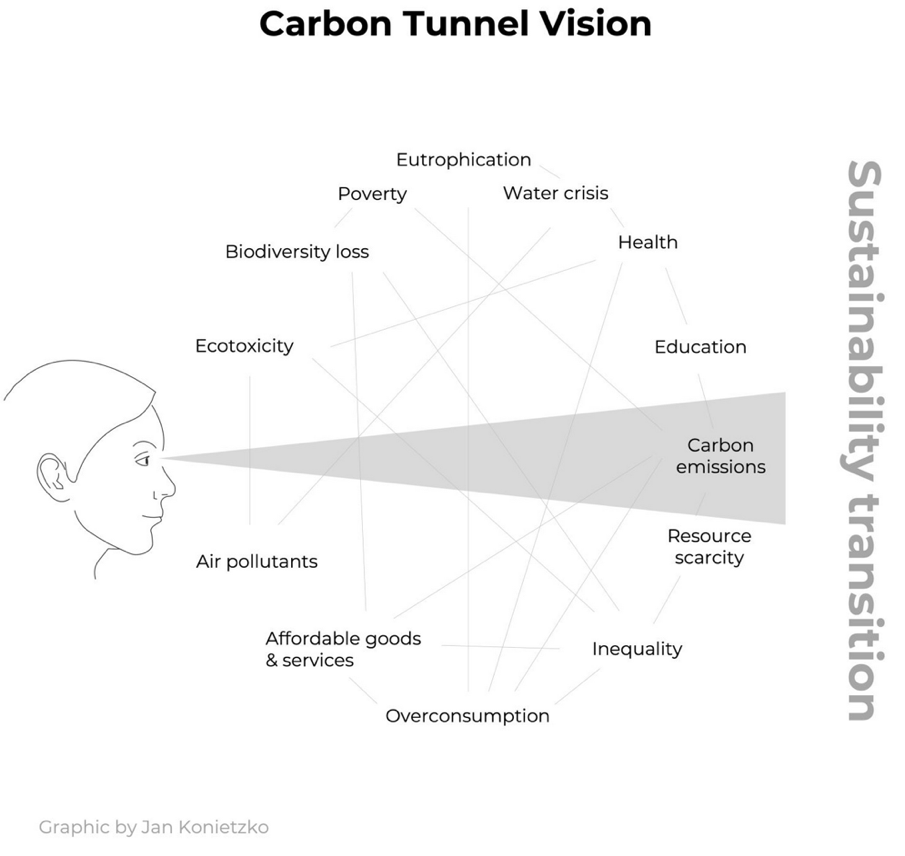
Image description: On the left center, an outline of a face is looking to the right with a gray-shaded area of focus from their eyes to the words "carbon emissions". Words like education, health, poverty, overconsumption, and inequality are organized in a circle with light gray connecting lines, but the person's singular focus on carbon emissions does not make those connections.
Climate change is a complex crisis that requires complex solutions. Just like we need to understand the systems of extraction and consumption that cause climate change, we need to consider the many overlapping systems that offer solutions and how they interact within larger systems like ecosystems, social structures, etc. It’s important to take a holistic approach. That doesn’t mean you have to do everything, it is a reminder that we exist in community.
This image called, “Carbon Tunnel Vision” shows a person with a gray-shaded area of focus from their eyes to the words "carbon emissions." Many other issues like education, health, poverty, overconsumption, and inequality are connected with light gray lines around the person, but their singular focus misses every one of those connections. What other connections are missing? What about Racism? War? Capitalism? Immigration? Displacement?
When we take a narrow focus to a complex problem like climate change, we ignore not only the interconnected challenges but we also significantly limit our possible solutions. The “and more” is so much more than just an “etc.” at the end! “And more” is a reminder that we should ask ourselves, “what does our community most need related to mitigation?” “What mitigation concerns might bring our congregation into this work?”
We must understand all of our climate work as part of a larger system that is constantly changing and that we must continuously adapt our understanding to respond. AI data centers are an excellent example of this. Five years ago, data centers weren’t widely known as a mitigation concern. In 2026, utility rates went through the roof because data center electricity demands skyrocketed - as did the pressure to build out gas pipelines to power the data centers and the new plans for AI companies to build their own, less regulated power centers.
💡 First Unitarian Church of Rochester, New York has been acting in deep solidarity with the Tonawanda Seneca Nation to block a new industrial park and proposed hyperscale generative AI data center on land surrounded on three sides by nature preserves, the Iroquois National Wildlife Refuge, the Tonawanda Wildlife Management Area, and the Big Woods. These facilities would consume vast resources, threaten the Nation’s well water and wildlife preserves, and impact cultural and subsistence activities. Solidarity with Tonawanda Seneca led anti-data center organizing prevents further resource extraction (Mitigation), follows the lead of a frontline community (Justice), partners with community organizations (Community Resilience) and collaborates within the congregation (Congregational Transformation).
🍃 Reduce resource usage in congregational buildings and grounds and individual homes and businesses.
Reducing our consumption is critical. Conducting resource audits, installing energy efficient windows or solar panels, converting energy & water-intensive mowed areas to native prairie, hosting maker-spaces or re-stores, supporting congregational and community learning and implementation needs, and advocating for improving energy efficiency in manufactured home parks are all impactful mitigation strategies. Congregational buildings and grounds offer incredible opportunities to reduce demand for resources while also serving as centers of learning for our communities. When we reduce our energy and water demands and share what we’re learning with our community, our impacts are so much greater.
💡 The Peterborough UU Church in NH greatly supported a community Window Dressers build, in which they made 141 window inserts for homes in the Monadnock Region. Twenty percent of these window inserts were given away to people who otherwise could not have afforded them. The project involved many people from the community, as we did outreach through their local Interfaith Council of Churches, food pantries and two area centers that assist families and youth in need. Window Dressers is a great example of how one campaign can cover multiple Essentials. Energy efficiency improves air quality and maintains cooler indoor temperatures in the summer and warmer in the winter for the energy produced, all of which build Community Resilience. It reduces the amount of electricity used, which Mitigates the emissions that drive climate change. When done in a way that prioritizes the needs of lower-income community members, the window inserts reduce energy burden - the percentage of a household’s income that goes towards energy - which reduces energy inJustice.
🍃 Embrace energy democracy, collaboratively advancing community-led climate solutions that prioritize justice.
To align our mitigation efforts with UU values, we need to advance climate solutions that prioritize justice, honor Indigenous sovereignty, protect our environment, and create thriving communities. Energy democracy presents an opportunity to create beloved community that shifts away from the extractive, centralized fossil fuel-based economy to nourishing, community-centered models. By collaborating with those most harmed by oppression and injustice to advance clean energy as a human right, we can improve community health and well-being and protect Earth and all beings from exploitation. Energy Democracy is a broad framework that encourages us to reconsider our relationship to Earth and to each other; to create new forms of governance, decision-making, and accountability; to rethink scale and distribution; to acknowledge, act, and repair harm; reflect on Rights of Nature; and so much more.
💡 Learn about energy democracy! Read the Ten Principles for Energy Democracy or watch What Is Energy Democracy? and discuss in small groups using a What? So What? Now What? framework (ex. What does this mean to you/for our community? What is important here/what UU values are guiding this? What might be our next move towards energy democracy?) The Energy Democracy Scorecard is a great resource to help you to assess the state of your energy economy and adopt a more equitable and democratic approach to how local energy is sourced, distributed and operated - do it in collaboration with your community partners!
Questions for Exploration
1) How does our UU faith call us to relate to our resources so those most harmed can thrive, not just survive? How can we shed our scarcity mindsets to grow into shared abundance? How can our actions be informed by what it means to relate to the elements, and each other, in a more reverent way?
💡 Consider: the difference between solidarity and charity; lived experiences of those most harmed as sacred truth; creating space for transformation; leaning into generosity and abundance, not scarcity; different ways of knowing and being; etc.
2) How do energy systems, transportation choices, land use, and other polluting systems harm our community in ways that go against our faith?
💡 Consider: rate structures, transportation inequities, poisonous infrastructure, placement of energy infrastructure, etc.
3) How are we in relationship with existing mitigation efforts in our area? How might our UU faith encourage a deeper commitment to justice in these initiatives?
💡 Consider: energy justice and energy democracy, climate action planning, frontline partnerships, and advocacy, etc.
4) What is our congregation's long-term goal for reducing consumption and increasing renewable resources?
💡 Consider: community decarbonization; water and energy usage; waste reduction; land (re)allocation; community gardens; etc. at the individual, congregational, and community levels.
5) What spiritual practices encourage us to be more courageously collaborative and imaginative while also practicing imperfection and change over time?
Congregations Taking Action on the Essentials
First Unitarian Church of Rochester, New York
The First Unitarian Church of Rochester, New York has been acting in deep solidarity with the Townawanda Seneca Nation to block a new industrial park on land surrounded on three sides by nature preserves, the Iroquois National Wildlife Refuge, the Tonawanda Wildlife Management Area, and the Big Woods. Because the permits were rushed through, the Nation and her allies are now fighting both a potential industrial park and a proposed hyperscale generative AI data center. In addition to consuming vast resources, the commercial operations of this facility would threaten the Nation’s well water and wildlife preserves. This project would impact wildlife in the Tonawanda Seneca Nation's Big Woods, where citizens practice cultural and subsistence activities including fishing and hunting. This campaign covers all four Essentials: it reflects a deep understanding of the systems of extraction and consumption that cause climate change and prevents further resource extraction (Mitigation); the congregation is following the lead of an Indigenous Nation and redistributed resources accordingly (Justice); they’re protecting critical ecosystems and partnering with 13 community coalitions to resist this data center (Community Resilience); collaborating in innovative ways, like hosting a jazz fundraiser for permit lawsuit legal fees and community education (Congregational Transformation).
We are delighted to recognize the First Unitarian Church of Rochester, New York for both 2025 and 2026 Green Sanctuary Recognition!
The Unitarian Universalist Congregation of Frederick, Maryland
The Unitarian Universalist Congregation of Frederick, Maryland greatly supported the Frederick County Data Center Referendum. This campaign is a good example of an action that covers all four Essentials. In this action, by partnering with their congregation’s democracy team and prioritizing both economic and environmental justice in your campaign, this congregation is shifting from isolation to collaboration (Congregational Transformation), prioritizing the concerns of our least-resourced community members (Justice), integrating climate impacts, farmland preservation, and broader environmental stewardship into a comprehensive campaign (Community Resilience), and preserving energy and water resources in your communities (Mitigation).
Although the Maryland Supreme Court struck down this data center referendum, their decision does not negate the tremendous growth in organizing ability and community connectedness this effort produced. We would also like to uplift the expansion of their congregation’s solar array and continued kitchen utensil mitigation efforts. It is clear this congregation is dedicated to the many types of climate work: from the daily decisions to the infrastructure resourcing and campaign pushes, the UU Congregation of Frederick is deeply faithful to the work of honoring the interdependent web of existence.
We are delighted to recognize The Unitarian Universalist Congregation of Frederick, Maryland for 2026 Green Sanctuary Recognition!
You can find more examples of congregational actions on all of the Essentials in the UU Climate Actions Database, which is linked in the Green Sanctuary 2030 Materials.
Resources for Going Deeper
Join
Fractal Practices for Faithful Climate Justice
November 18, 2026, 7 PM - 8:30 PM ET
Reimagine Together Again (and again and again...) The Climate Justice revival energy continues with an invitation to Reimagine Together: Fractal Practices for Faithful Climate Justice. Designed to flexibly meet the needs of your congregation or organization, this new curriculum invites us to Begin Together & then proceed in all learning directions, developing and nourishing the skills and connective tissue necessary for participating in the possibilities of a world where all beings may flourish. The Rev. Deanna Vandiver of Ever Unfolding and Rev. JeKaren Bell, UUA, both members of the original UU Climate Justice Revival Planning Team will join us to introduce this encouraging resource. --- Guided by UU values, the Green Sanctuary community nurtures resilient, thriving communities through climate actions that prioritize justice. All are invited to join our monthly community meetings to learn together, support each other, and celebrate progress.
Public Utilities Commissions: The Growing Fight for Clean Infrastructure
November 18, 2026, 6 PM - 7 PM ET
Join the Energy Democracy Project and the Climate Advocacy Lab for this workshop. In the recent fights against data center expansion, more advocates are learning about the often-overlooked forum for decision-making on energy: Public Utilities Commissions (PUCs). These commissions provide state oversight and regulation of utilities like electricity, gas, water, and transit. PUCs are a direct line to those entrusted to protect the affordability, health, and safety of utilities. Learn how local organizations are fighting for safe, clean, and affordable utilities and infrastructure.
Read
UU Tools
The Questions for Exploration: Mitigation Section in the Green Sanctuary 2030 Materials is a fantastic resource. Bring these questions to your next climate ministry meeting!
Other Tools
Watch/Listen
Defending Public Lands | Standing Rock Anniversary: Recording & Resources | Side with Love Our October 2026 Green Sanctuary 2030 Community Meeting focused on Defending Public Lands | Standing Rock Anniversary. As part of our Standing Rock Anniversary events, Deb Cruz from JUUstice WA, outlined the Trump Administration’s attacks on Public Lands and how our congregations can engage with the Defend Against the Assault on Environmental Protections: Public Lands Rules and the Endangerment Finding.
How High Are Household Energy Burdens? An Assessment of National and Metropolitan Energy Burdens across the United States Even before the COVID-19 recession, energy bills strained many family budgets—and some far more than others. ACEEE found that low-income households, as well as Black, Hispanic, and Native American households, face dramatically higher energy burdens—spending a greater portion of their income on energy bills—than the average household. These communities also experience acute systemic inequalities, barriers, and limited access to public and private resources, and they are now being hit the hardest by job losses and the health impacts of the pandemic.
What Is Energy Democracy? From the Energy Democracy Project. In July 2019, 36 leaders of energy democracy initiatives across the U.S. convened to build their collective power and advance the movement to democratize energy. This Strategic Convening on Energy Democracy was a collaboration of over 20 local organizations across the U.S. to build stronger relationships and capacities to democratize energy in our country. This national gathering emphasized the centrality of race to energy issues and the goal of empowering our communities through energy democracy.