Exploring the Essentials of Climate Justice: Community Resilience
Community Resilience: Cultivating communities of care to prepare for and respond to climate disruption
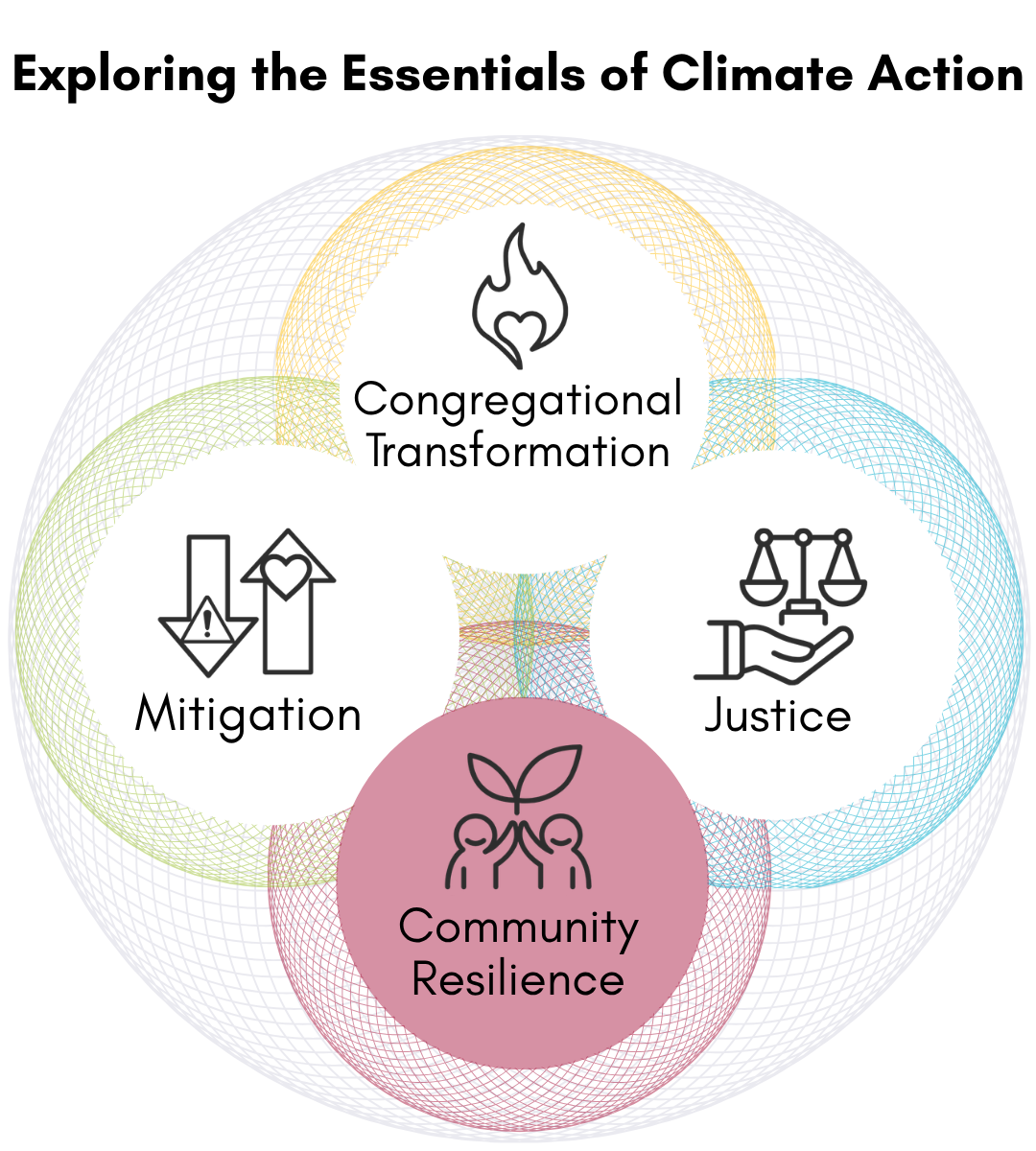
Exploring the Essentials resources support you to advance balanced, faith-rooted climate actions that prioritize justice, center love, and respond to the needs of your community by aligning your actions to the Four Essentials of UU Climate Action: Justice, Community Resilience, Mitigation, and Congregational Transformation. We hold monthly gatherings and share congregational examples, resources, and more. This month, we’re exploring the Community Resilience Essential.
Why is Community Resilience Essential?
Pause a moment to reflect: As Unitarian Universalists, how can we center the inherent worth and dignity of every person in extreme heat? How can we cultivate beloved communities with the people around us and interdependence with the ecosystem that supports us? What spiritual practices can nourish our spirits as our climate changes? How does our faith call us to generously and compassionately share our resources so that everyone can flourish with dignity, love, and compassion in the face of climate disruption?
We know that climate disasters are becoming more frequent, that our Earth and all beings are being exploited more and more every day, that our spirits are strained by the weight of this knowledge. Our response to this awareness lies at the heart of the Community Resilience Essential.
Because our faith centers love and prioritizes justice, UUs have a vital role to play in keeping our communities safe. The Community Resilience Essential helps us understand the challenges we face and strengths we can build on while creating opportunities for spiritual and community connections as we prepare for and respond to climate disasters.
How the Community Resilience Essential helps
Each Essential includes primary ways to bring the Essential to life in your community. You don’t have to do all of them all at once; consider them parts of a whole that you create through ongoing actions that deepen over time. Those are listed below, starting with the lightbulb emoji (💡) with some explanation and congregational examples or suggestions for activities.
🍃 Understand how climate change harms your community—who, how, and where.
It’s not enough to just know the science, we need to know who is most at risk so our climate actions can faithfully prioritize justice and center love. When I help people understand climate injustice, I almost always start with climate disasters because they lay bare the underlying social inequity in our communities.
How do climate disruption and injustice affect your community? Whose lives are most at risk in extreme heat and cold? Who would struggle to evacuate during a wildfire or hurricane? Once you notice climate injustice in your neighborhood, you begin to recognize climate injustice everywhere. When climate solutions center those most harmed, our whole community is more resilient.
Focusing on who will be hurt worst by climate change, how, and where is a primary - and faithful - way to prepare for and respond to climate disasters. Partnering with your Racial Justice team, the folks who run the Immigrant support network, or the people who run the food pantry is a great way to strengthen congregational connections while making the connections necessary to keep your community safe in a climate disaster.
💡 Invite your social justice teams to a watch party and discussion on Climate Justice is Social Justice or do some activities in the Fostering Climate Resilience and Community Care: Disaster Preparedness and Response for UUs Toolkit. Both are linked in the resources section at the end of this page.
Like a strong ecosystem, could we nourish each other? How can we support not just environmental resilience, but also spiritual and emotional resilience? What practices could we bring to our gatherings to carry us through difficult times including celebration, rest, and reflection?
🍃 Understand the strengths and challenges for the ecosystem in your area.
Knowing how our ecosystem cares for us and where our ecosystem needs care is critical. A strong ecosystem mitigates climate risks. When we protect natural wetlands, they act as sponges holding excess water during heavy rainfall. Native plants reduce the need for fossil-fuel intensive chemicals and landscape maintenance. In urban neighborhoods that experience some of the most extreme heat, trees cool the air. It is a reciprocal relationship of mutual care.
💡 Unity Church Unitarian in St. Paul, MN cultivated relationships with “tree adopters” in the historically Black Rondo community that was scarred and bisected when a freeway was built. They’ve planted hundreds of trees that sequester carbon, clean the air, boost mental and physical health, while protecting biodiversity and providing habitat.
Like a strong ecosystem, could we nourish each other? How can we support not just environmental resilience, but also spiritual and emotional resilience? What practices could we bring to our gatherings to carry us through difficult times including celebration, rest, and reflection?
🍃 Create spaces to nourish your spirits by connecting with nature, art, and each other.
It is okay to feel the grief and fear that come with climate disruption and environmental degradation. But we can do this work together, joyfully, with a spirit of gratitude and hope. Collaborating with the worship team, religious educators, and the grounds crew are all great ways to increase collaboration within your congregation while creating spaces for play and contemplation, opportunities for joy, wonder, and connection.
💡 First UU Ann Arbor, Michigan’s Earth Day worship was a wonderful collaboration between the Worship Team, Religious Education, Artists, Writers, Friday Fun Teams, UU Civic Engagement Team and more. Congregants were welcomed with a nature art and poetry display in the hallway. Their service included their annual Dirt Communion with an outdoor celebration in their Ancestors Grove. The social hall was alive with energy after each service with climate information and displays, artist designed nature notecards for sale, a civic action postcard campaign and more.
🍃 Cultivate spiritual, relational, and infrastructural strength to prepare for and respond to climate disasters.
Usually when we think about building community - or climate - resilience, we think about things like offering our congregations as cooling and warming centers for extreme heat or shelters during storms, or putting on solar panels and battery backup so folks who need electricity for oxygen or dialysis can be safe when the power goes out. We call these Hubs of Climate Resilience. Hubs can be doing things like creating a network of mutual care, partnering with an at-risk neighborhood to support their resilience efforts, or becoming a resource hub on disaster preparedness. There are as many ways to create a hub as there are UU congregations, because hubs respond to the needs of the community.
💡 Participants in our Creating Hubs of Climate Resilience Peer Learning Circle representing eight UU congregations shared their answers to the question, “Why should our congregations become hubs of climate resilience?” during the last Green Sanctuary Community Meeting Creating Hubs of Climate Resilience and Community Care. Read their responses, watch the video, and check out our whole Climate Resilience Hubs Resource Guide.
🍃 Collaborate with community partners to strengthen community resilience and care.
Relationships are the most resilient network, the strongest infrastructure we can invest in to keep everyone in our community safe and protected. The good thing is that most congregations already have relationships with the community. Centering love and prioritizing justice, think about who is most at risk when disaster strikes. What stakeholders need to be engaged in climate resilience planning? Think about which relationships are missing. What relationships can we nurture? How can we become part of a conversation in our broader community around creating hubs of climate resilience?
💡 Where do we start? Do some asset mapping! The First Unitarian Church of Des Moines is exploring how to share their skills, time, and resources as a Rapid Response Team for the local community. They explored current pressing issues to understand how harms are felt across issues and identified the marginalized communities in Des Moines, the depth of the congregation’s current relationships, and how community partner relationships could be deepened. They used the Side With Love Asset Mapping tools which help congregations identify what we have, so we are able to faithfully and quickly respond to asks that may come through ongoing partnerships as well as in moments of rapid response. You can do it, too!
If your beloved neighbors come to your congregations when they’re hungry for food or spiritual nourishment, they will also come to your congregations when they are soggy from a flood or overheating during yet another heat wave. Are you prepared to love them? You can be, and the Community Resilience Essential can help.
Questions for Exploration
How does our Unitarian Universalist faith prioritize care for those most harmed by an uncertain future?
How do climate disruption and injustice affect our community? Specifically who is most impacted, how, and where?
How are we working with existing community resilience efforts? How might our UU faith encourage a deeper commitment to justice in these efforts?
If we prioritize the needs of those most harmed, how does that call us to share resources to build community resilience?
How can we care for people experiencing grief, anxiety, distress related to climate disruption?
Below you’ll find some more examples of congregations taking action on the Essentials. Check out the Database of UU Climate Actions for even more! There are also tons of resources and lots of ways to get involved.
If you appreciate this work please consider supporting the Green Sanctuary 2030 program with an individual donation or by organizing a pass the plate to make sure all UUs have the support they need to transform our communities through climate justice.
You can make a donation using the QR code here or by going to bit.ly/SupportUUClimateJustice.
In community,
Rachel Myslivy
UUA Side With Love Climate Justice Strategist
Congregations Taking Action on the Essentials
Hubs of Climate Resilience Peer Learning Circle Congregations
Climate disasters are only getting worse and more frequent. Creating Hubs of Climate Resilience is a critical way our congregations can keep our communities safe. UUs everywhere are rising to the challenge. As part of our Climate Resilience Peer Learning Circle, ten UUs collaboratively explored possibilities for creating hubs that center love & prioritize justice. These congregations are creating hubs that are “not a bunker, a beacon” grounded in UU values & responsive to their community’s needs. There are as many ways to create a hub as there are UU congregations, because they respond to the needs of the community. We’re writing up case studies about the ways these UU congregations are doing this work (you can, too!) but for now, we invite you to read why they all think our congregations should become Hubs of Climate Resilience. We extend deep appreciation for the hard work of the congregations in the Peer Learning Circle for helping to create the Hubs of Climate Resilience Resource Guide.
First Unitarian Universalist Church of Richmond, VA
First UU Congregation of Ann Arbor, MI
UUs of Grants Pass, OR
UU Church of the South Hills, PA
Unitarian Society of Santa Barbara, CA
Unitarian Universalist Society of Fairhaven, MA
Unitarian Universalist Congregation of Atlanta, GA
First UU Church of Rochester, MN
The First UU Church of Rochester, MN has beautifully dedicated themselves to a 38-acre Viola Land Stewardship project, a tremendous Community Resilience and Mitigation effort. Rewilding and creating conditions for native biodiversity to thrive reduces the need for fossil-fuel-intensive chemicals, serves as a source of carbon sequestration, improves water quality, reduces erosion, and so much more. This Viola Land Stewardship will create spaces to reconnect with nature & nourish spirits, fostering Community Resilience. This deep connection with place will deepen the spiritual life of both their congregation and the larger community. To strengthen their Justice Essential, the congregation is watching Side With Love’s Climate at the Intersections videos, like Climate Justice is Immigrant Justice. The UUs in Rochester already have strong partnerships with the immigrant community in the area. Our immigrant neighbors are among those most at risk of climate disruption. All of this work helps create Community Resilience in Rochester today and in the future.
Resources for Going Deeper
Join
Defending Public Lands | Standing Rock Anniversary
October 21, 2026 7:00 PM - 8:30 PM ET - Online
The Trump Administration has removed protections from more than 86 million acres of public lands, and millions more of our beloved landscapes and wildlife are in imminent danger of expanded mining, drilling, and timber harvests with limited consultation with Tribes and Nations and public comment. As our lands, waters, and habitats are under attack, UUs passed the 2026 AIW to Defend Against the Assault on Environmental Protections: Public Lands Rules and the Endangerment Finding. As part of our Standing Rock Anniversary events, join Deb Cruz from JUUstice WA, for a discussion about current issues and how we can protect public lands from the onslaught of logging, fossil fuel and other extractive industry projects.
---Guided by UU values, the Green Sanctuary community nurtures resilient, thriving communities through climate actions that prioritize justice. All are invited to join our monthly community meetings to learn together, support each other, and celebrate progress.
Find the full list of Green Sanctuary meetings at SideWithLove.org/ClimateJustice and at the bottom of this page.
Watch/Listen
Videos featuring Unitarian Society of Santa Barbara’s Resilience Hub
Sign up for all of the upcoming Green Sanctuary 2030 Community Meetings
Deb Cruz, JUUStice WA.
Rev. Deanna Vandiver, Ever Unfolding
JAN. 27* Green Sanctuary Celebration!
Rev. Michael Crumpler, UUA LGBTQ & Multicultural Programs Director
Mathew Jensen, Senior Investment Officer, UUA Investment Office & Common Endowment Fund
APR. 21 To Be Determined!
Office Hours: 1st Wednesday of the month 7PM - 8PM ET
Community Meetings: 3rd Wednesday of most months* at 1HT - 3AKT - 4PT - 5MT - 6CT - 7ET.
Watch all previous Community Meetings at https://www.sidewithlove.org/climatejusticetrainings
Read
Become a Climate Resilience Hub in Your Local Community UU World Article on the Hubs of Climate Resilience Peer Learning Circle
Much of what we’re already doing creates climate resilience - Side With Love Action Center Update
UU Tools
This new resource is a growing toolkit builds on our existing resources on Disaster Preparedness and Response and features climate resilience hub examples from UU congregations, a collection of UU climate resilience resources, spiritual nourishment for climate resilience, and opportunities for UUs to contribute to this resource. The Questions for Exploration: Centering UU Values When Creating Climate Resilience Hubs is a beautiful tool to deepen faithful engagement in climate resilience hubs.
“Asset Mapping” is the intentional process of identifying the infrastructural, financial, human, and spiritual resources of a community, with the intention of leveraging those assets for the common good. Through asset mapping, we identify what we have, so we are able to faithfully and quickly respond to asks that may come through ongoing partnerships as well as in moments of rapid response.
Other Tools
Emergency Essentials for people who don’t want to make disaster prep their whole personality. Come What Mayday was a favorite of the Hubs of Climate Resilience Peer Learning Circle
Mutual Aid Disaster Relief is a grassroots disaster relief network based on the principles of solidarity, mutual aid, and autonomous direct action.