Essentials of Climate Action: Justice
JUSTICE: Partnering with those most harmed by climate change to build thriving communities.
That may seem easy enough, but the Justice Essential is the one congregations struggle with the most - or as I like to say, Justice is the Essential with the most potential. Let’s explore.
You may be thinking, we already do justice in our climate work. Justice is part of our faith. It’s addressed by our congregations. Isn’t justice woven into all of our ministries?
Not always. The reality is that without an intentional, active commitment to centering justice, it becomes much more likely that our efforts will unintentionally uphold injustice. Let’s explore how justice is essential for climate action.
Marginalized communities are hurt first and worst by climate disruption and they’re often least resourced to adapt and respond to changing climate conditions - and that’s usually by design. Consider the racist housing policy of redlining which blocked people of color from getting mortgages, led to racial and socioeconomic inequality, and left a legacy of air pollution, health inequity, and disproportionate climate impacts. Historically redlined communities now experience the most extreme heat and a higher risk of floods (climate justice); are twice as likely to be occupied by fossil fuels (environmental justice); and spend over 40% more on energy than white households (energy justice). Redlining provides clear connections between racism and climate justice, environmental justice, and energy injustice.
The Justice Essential helps us explore ways to understand how climate disruption, environmental injustice, and energy injustice impact some worse than others.
Think about climate change, high energy rates, environmental degradation, pollution, etc. Ask yourself: How do these things hurt my community? Who is hurt first and worst? How? Where? While your first response might be to jump right into the needs and how your congregation can fill them, it is so important to first, first, first before you go flying out the door ready to help, ask yourself: who is already doing this work in the community? Who are we in relationship with already? Who could we build better relationships with?
It’s important that we follow frontline leadership and advance their priorities.
Why? Because the people closest to the harm know what they need. If the neighborhood most impacted wants to work on rent control and you want them to weatherize their homes, you help with rent control. Keeping people housed is a climate resilience strategy and it’s a critical way to center justice in the work.
Collaborate with curiosity and humility, as we do this work together.
Even if you are an energy wonk with decades of experience, honor and learn from another’s lived experience. You may know everything about home energy assessments but nothing about how to decide whether to pay for utilities, groceries, or your child’s inhaler while facing eviction.
Embrace solidarity, not charity, sharing resources, knowledge, and power as equals.
We all have things to learn and things to offer. It’s a shift from scarcity to abundance, paternalism to community care, status quo to collective liberation. We create thriving communities together, not one group saving the other.
While you’re exploring the Essentials, don’t forget that the new Green Sanctuary process also has Five Approaches to Support your Team. The Essentials and the Approaches work together.
Grounding in Our Context can be particularly helpful as we approach the Justice Essential because we need to understand how oppression shapes our community to really understand who is hurt worst by climate disruption. You could start by start by figuring out what parts of your community were redlined. If you’re thinking, phew, my community was too small, rural, or out west to be redlined, find out if yours was a sundown town, what treaties were broken with Indigenous people? Go back as far as you can, then scan up to today. How are immigrants kept from thriving in your community? Unhoused neighbors? People with disabilities? Are trans people truly beloved in your community?
Climate justice is racial justice. It’s also LGBTQIA+, gender justice, disability justice, economic justice, Earth justice, and more. And for many in the climate movement, thinking about things with justice as primary is a new way of doing the work. That’s why it’s the Essential with the most potential!
You’ve got this!
I hope you’ll join us for this month's Green Sanctuary Community meeting on Creating Hubs of Climate Resilience and Community Care on September 16 at 7ET. RSVP TODAY!
Next month with resources to help you Explore the Community Resilience Essential, too.
Now, go check out how some 🌟[sparkle emoji] congregations are taking action on the Justice Essential🌟 [sparkle emoji] below. Then go deeper with some curated videos, tools, articles, and more to help you explore the Justice Essential.
In community,
Rachel
Rachel Myslivy, UUA Side With Love Climate Justice Strategist
Taking Action on the Justice Essential
UU Fellowship of Hendersonville, NC.
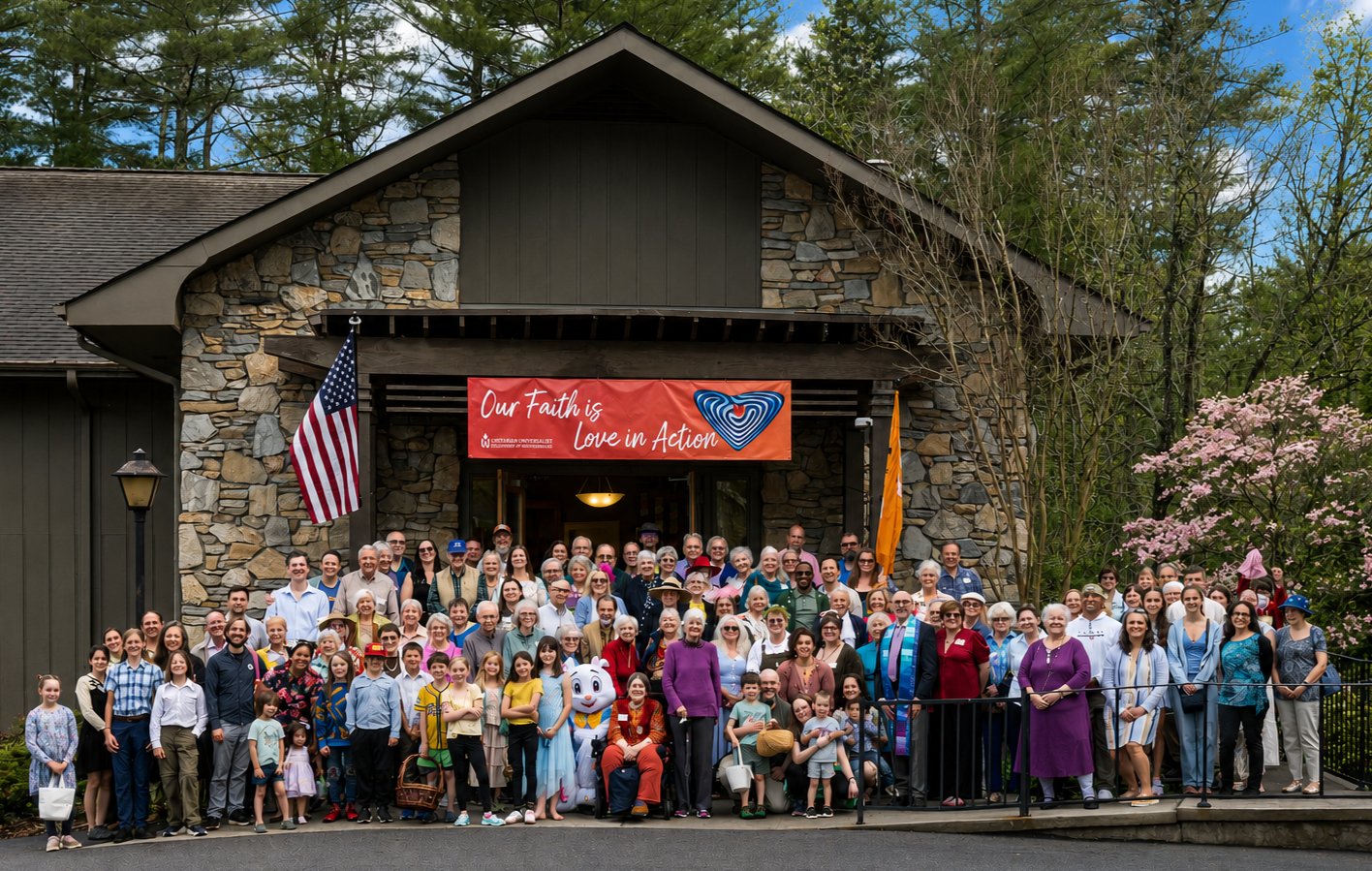
Image description: A crowd of people stand outside of a building made of brick and wood panels. There are flowering trees to the right. The building has a red banner with white text that reads “Our faith is love in action”.
Last year, in the wake of devastation of Hurricane Helene, the UU Fellowship of Hendersonville, NC. partnered with a local Black Baptist church, a Jewish disaster response organization, and the NAACP to support the disaster recovery of a local majority-Black neighborhood.
Together, they raised over $10,000, which helped three community members refurbish their homes. This whole-congregation effort involved the climate, family ministry, endowment, and racial equity teams.
The UUs in Hendersonville have nourished a relationship with their neighbors in this community. This year, they partnered to bring in disaster recovery groups and elected officials to get clarity on ongoing disaster recovery resources. Members of the congregation were even invited by community members to cross Pettus Bridge in Selma with them.
This is a great example of the Justice Essential because they partnered with those most harmed by climate disruption and the UUs in Hendersonville followed the leadership of the community most impacted, organizing for solidarity - not charity.
We’re happy to celebrate the UU Fellowship of Hendersonville North Carolina’s Green Sanctuary Recognition 2025 and 2026 for these efforts. Congrats!
UU Congregation of Gwinnett, GA
The UU Congregation of Gwinnett aligned with frontline groups and other UUs to fight for utility justice and clean energy in Georgia.
The UU Climate Justice Revival brought together members working in different justice-related ministries to advocate for low-income Georgia residents whose electricity rates skyrocketed and power shut offs increased while investors profited. The high cost of electricity disproportionately impacts low-income populations which creates a higher energy burden on marginalized communities.
The Georgia Public Utility Commission had approved six electricity rate increases in two years. Allied with Partnership for Southern Equity, Gwinnett UUs learned how to articulate the impacts on energy burden to make the case for fair energy rates. For instance, the loss of service is a primary cause of homelessness and removal of children from their homes. Their advocacy culminated in the election of two new Commissioners who were more aligned with values of fairness in the system. Advocating for fair electricity rates or increasing renewable energy at the regulatory level is one of the greatest opportunities to advance climate justice, energy justice, and utility justice.
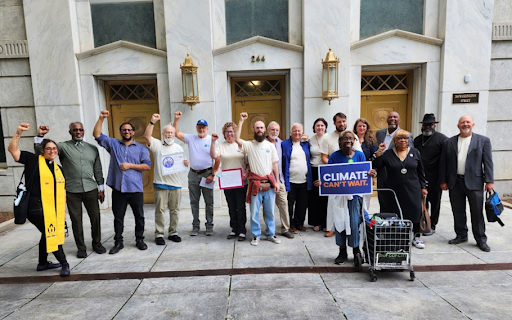
Image description: A group of people are outside, many holding their fists in the air. One person holds a sign that says, “Climate can’t wait”.
This is a powerful example of how one strategic campaign can cover all four Essentials:
Justice: collaborating with curiosity, they learned from frontline leaders how energy injustice was harming some in their community more than others. They acted in solidarity, recognizing that the problems were systemic - not easily fixed with a one-time fundraiser to help pay bills but critical to address at the source, the Public Utility Commission.
Mitigation: their advocacy included a push for increased renewables in the Utility’s Integrated Resource Plan.
Congregational Transformation: they hosted the Climate Justice Revival as designed which led to powerful collaboration within the congregation.
Community Resilience: they took actions based on the understanding that utility shut-offs lead to homelessness. Unhoused people are on the frontlines of climate disruption - keeping people housed is a climate resilience strategy. You can learn about their campaign from Green Sanctuary 2030 Community Meetings, Claiming Our Power to Fight for a Clean Energy Future and a short update during the 2026 Green Sanctuary Celebration.
The UU Congregation of Gwinnett, GA celebrated Green Sanctuary Recognition in 2025 for these efforts and continues to take faithful climate actions that prioritize justice in Georgia.
You can find more examples of congregational actions on all of the Essentials in the UU Climate Actions Database, which is linked in the Green Sanctuary 2030 Materials.
Go deeper
Watch/Listen:
Climate at the Intersections Videos are short videos exploring how climate connects to justice & UU Values. They’re great for starting conversations in your congregation!
Green Sanctuary Community Meetings
Love is the Framework for Climate Justice with Elio Farley
Engaging Marginalized Communities with Rev. Ranwa Hammamy
Join:
Creating Hubs of Climate Resilience and Community Care
September 16, 2026 7:00 PM - 8:00 PM ET
Climate disasters are only getting worse and more frequent. Creating hubs of climate resilience is a critical way our congregations can keep our communities safe. UUs everywhere are rising to the challenge. As part of our Climate Resilience Peer Learning Circle, ten UUs collaboratively explored possibilities for creating hubs that center love & prioritize justice. Learn how these congregations are creating hubs that are grounded in UU values & responsive to their community’s needs. Be the first to receive our resources for UUs creating hubs of climate resilience and community care. --- Guided by UU values, the Green Sanctuary community nurtures resilient, thriving communities through climate actions that prioritize justice. All are invited to join our monthly community meetings to learn together, support each other, and celebrate progress.
Sign up for this and all of our Community Meetings at SideWithLove.org/ClimateJustice
Practice:
In the new Green Sanctuary 2030: Mobilizing for Climate Justice materials, each Essential and Approach includes a systems tool and questions to explore the content. They’re built into a sample 90 minute agenda that you can use in whatever way works for your team. These tools are part of those agendas. To review all of the practices and sample agendas, download the full set of GS2030 materials
Practice: Mapping Challenging Realities | Grounding in Our Context
Understanding how different injustices are connected helps to more effectively identify the specific conditions we want to change.
Practice: Mapping Community Care | Exploring the Possibilities: Justice
To create thriving communities, we need to understand who is most impacted by climate, energy, and environmental injustice and take faithful actions that advance justice. Understanding how different injustices are connected helps to more effectively identify the specific conditions we want to change.
The new Mosaic Congregations Framework is brilliant. We encourage UU congregations to pursue this transformative curriculum. (Participation in Mosaic meets the GS2030 Justice and Congregational Transformation essentials.)
Sign up for all of the upcoming Green Sanctuary 2030 Community Meetings
SEP. 16 Creating Hubs of Climate Resilience and Community Care
Hubs of Climate Resilience Peer Learning Circle
OCT. 21 Protecting Public Lands Standing Rock Anniversary
Deb Cruz, JUUStice WA.
NOV. 18 Fractal Practices for Faithful Climate Justice - Adult Faith Formation
Rev. Deanna Vandiver, Ever Unfolding
JAN. 27* Green Sanctuary Celebration!
FEB. 17 Racial Justice is Climate Justice
Rev. Michael Crumpler, UUA LGBTQ & Multicultural Programs Director
MAR. 17 What Does Your Money Believe? Faith, Wealth, and Climate Justice
Mathew Jensen, Senior Investment Officer, UUA Investment Office & Common Endowment Fund
APR. 21 To Be Determined!
Office Hours: 1st Wednesday of the month 7PM - 8PM ET
Community Meetings: 3rd Wednesday of most months* at 1HT - 3AKT - 4PT - 5MT - 6CT - 7ET.